A characteristic holiday home, restyled by VMCF Atelier
On the Maremma coast (Tuscany) there is an extraordinary concentration of modernist villas to be rediscovered. The construction of these holiday homes dates back to the post-war decade of 1955-1965, when the boom in seaside tourism in Italy gave rise to new urban realities and perspectives and continued until the 1980s. Along the coastal pinewood, from Capezzolo to Punta Ala, new urban areas were created for second homes and luxury residences, perfectly integrated into the surrounding landscape. In this context, some of the most important examples of modern residential architecture were created by the most illustrious architects of the time.
The pinewood of Roccamare extends inland and follows the entire coastline of the Tuscan town for about eight kilometres, sheltering from the wind and the sun interesting houses such as Villa Bartolini - designed at the end of the 1950s by the then promising architect Ernesto Nathan Rogers, author, together with the BBPR group, of iconic projects such as Torre Velasca - and others born of the passion of Count Ginori Conti and some important designers such as the architects Ugo Miglietta and Pier Niccolò Berardi.
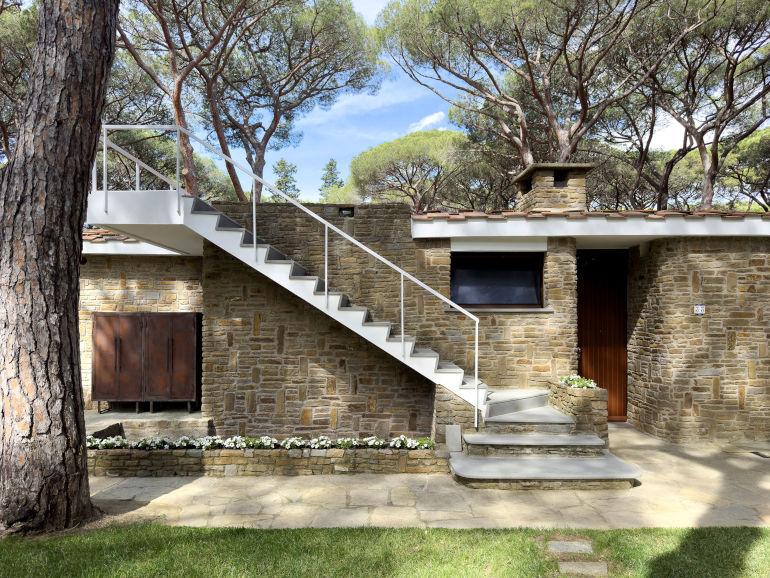
Roccamare is a private residential complex, mainly designed by the architect Ugo Miglietta in the 1950s, consisting of over two hundred modernist villas built from 1963 onwards. The "ville in Pineta" (villas in the pinewood) were mainly built between 1963 and the 1980s.
Architect Valerio Ferrari - founder with his wife, fellow architect Cinzia Mazzone, of the studio VMCF Atelier - spent his childhood holidays here. "It is a magical place because it is unspoilt and wild", he says. "It is not crowded, not even in August". Many years later, he and Cinzia bought a house designed by Miglietta and built in the 1970s, including an adjoining seven-bedroom guest dépendance, and transformed it with respect for the original structure and a keen sense of contemporary art.
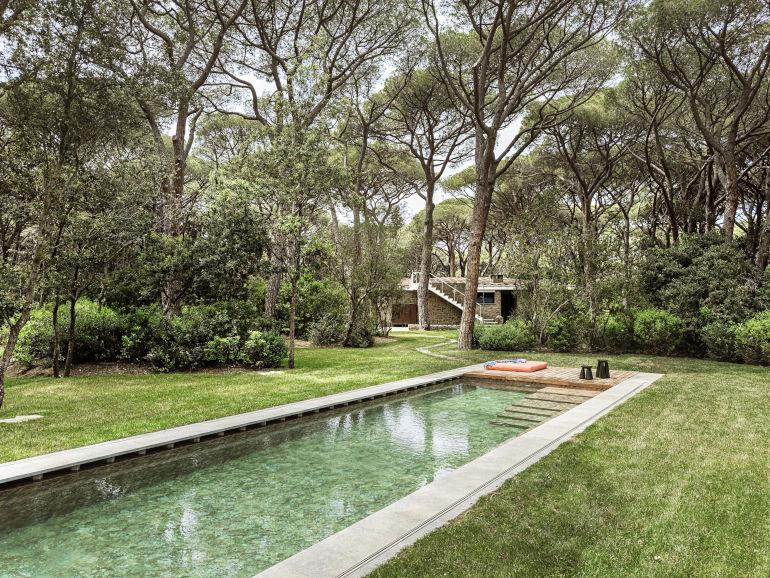
The property is situated just a few steps from the sea. It covers an area of almost one hectare and includes a swimming pool.
The overall concept of the project has a strong scenic component combined with a sophisticated ability to integrate the arts, which stems from the training of the two architects. VMCF Atelier, which stands for Visual Machine Concept Facilities, was founded in Paris in 2003 and is now based in Milan. It has designed sets for opera and dance, and Ferrari and Mazzone have also collaborated on art installations.
It is no coincidence that a bespoke steel media cabinet - ironically dubbed the "media boar" by the architect - moves in and out of a wall like a stage set; the internal doors are maple partitions that rotate on an axis, similar to theatre wings. Mazzone emphasises that "these play a central role in the house, blurring the boundaries between rooms and creating ambiguous spaces".
Even the window frames are spectacular, crossed by diagonal steel frames reminiscent of Alison and Peter Smithson's Hexenhaus. But the spotlight is stolen by an extraordinary piece of floor art that takes over the living room like a stage.
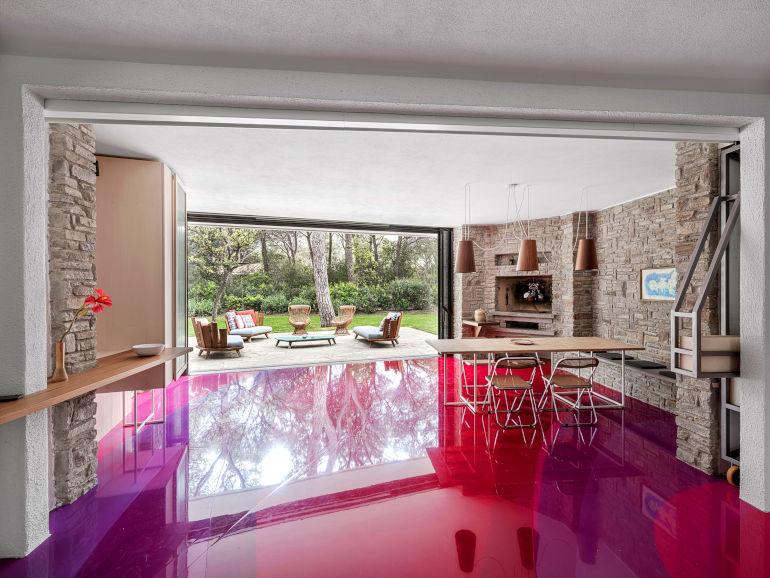
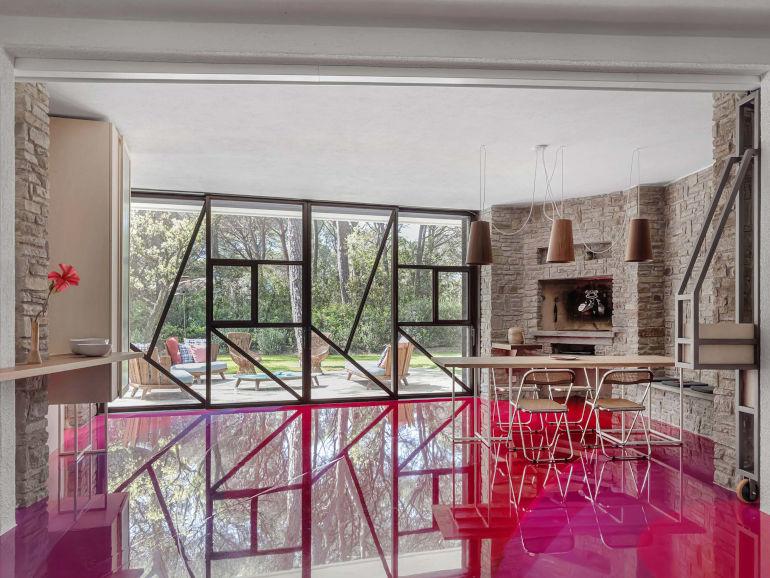
The author is the German artist Peter Zimmermann, who spent two weeks on site applying seven layers of epoxy resin to create an unexpected, dynamic and energetic effect that contrasts sharply with the house, while highlighting its unique features. The floor contrasts with the original Castiglione sandstone interior walls, an OSB-topped dining table, wicker chairs and bleached maple furniture. "We mixed natural and pop colours, shapes and materials", says Ferrari.
The resin is so shiny and brightly coloured that when the sun shines through, the floor reflects the furniture and the trees outside. The constant indoor-outdoor interaction is created by reverberation and is the other dominant feature of this villa.
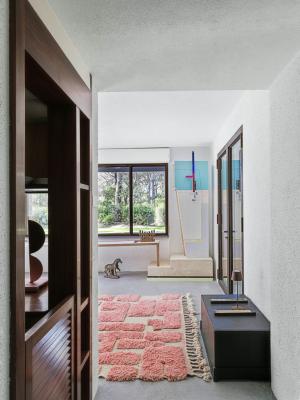
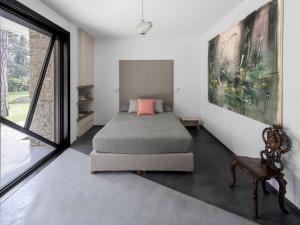
Inside, bold accents alternate with minimalism, especially in the bedrooms, with custom-made jute headboards and lacquered pine wardrobes. The pendant lamps by Italian artist Maria Grazia Rosin, made of Technogel, an experimental plasticizer-free material, and Murano glass, are the result of another study focusing on contrasts. Here, too, the micro-cement floor is divided into two shades of grey to create a graphic effect that contrasts with a 19th-century chair or a contemporary painting on the wall.
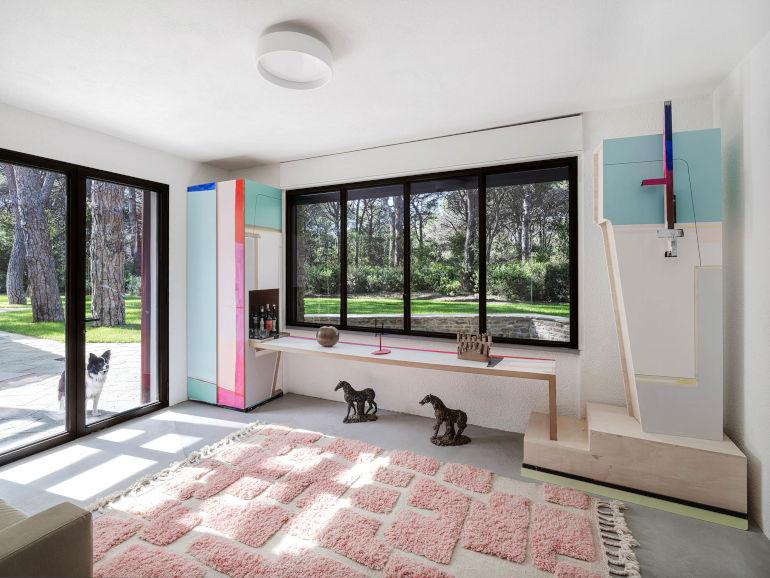
Art and architecture constantly interact: in the kitchen, the wall tiles have a motif inspired by the drawings of Chilean painter Roberto Sebastian Matta, with whom Ferrari collaborated in the 1990s on a project for a museum in Santiago de Chile. In the dépendance, the young German sculptor Christian Henkel built a plywood cabinet sculpture on which he painted geometric lines in shades of blue and pink.
In the main bathroom, the wall tiles at the top have been removed, but the glue has been left to form an abstract pattern, and the ceramic tiles are by Le Corbusier. An interesting feature is the plumbing between the bathtub and the shower.
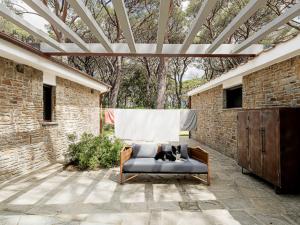
On the outside, the design intervention by Mazzone and Ferrari takes on a more neutral and conservative tone than the original project by Miglietta.
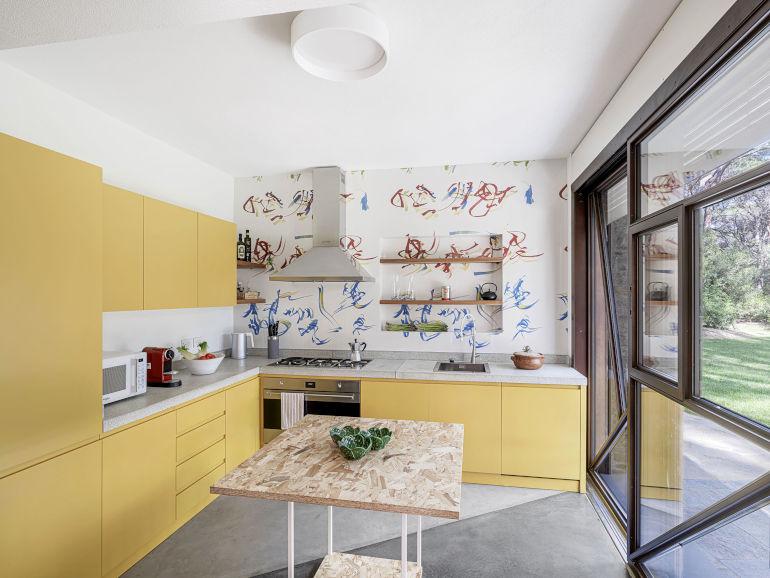
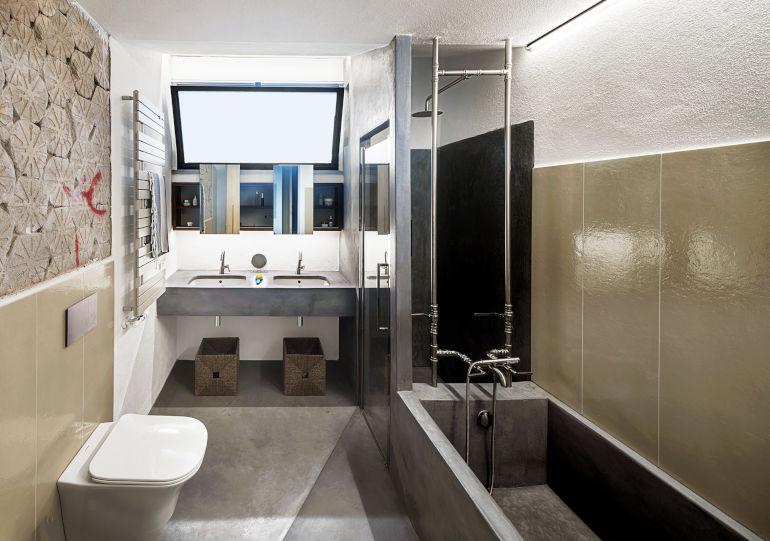
PHOTO CREDIT: Eric Laignel